Showing posts with label Brian Barnes. Show all posts

Monday, July 15, 2019

Life of Illusion

“Sometimes, I can’t help but feeling that I’m living a life of illusion.” Joe Walsh, “Life of Illusion”
I love starting the weekend listening to WXRT’s “Saturday Morning Flashback,” especially when I can hear such 1981 favorites as “The Voice” by Moody Blues, “Shake It Up” by the Cars, “867-5309 (Jenny)” by Tommy Tutone and surprises such as “Champagne and Reefer” by Muddy Waters and “Life of Illusion” from the album “There Goes the Neighborhood” by guitar great Joe Walsh, whom I saw live in Merrillville with Ringo Starr and His All-Star band.  “Life of Illusion” dispenses this advice:
Hey, don't you know it's a waste of your day
Caught up in endless solutions
That have no meaning
Just another hunch, based upon jumping conclusions
Backed up against a wall of confusion

The new Morrissey CD “California Son” contains covers of songs originally recorded by the likes of Bob Dylan, Buffy Sainte-Marie, Joni Mitchell, and Phil Ochs. “Days of Decision” by Ochs strongly resembles “These Are Days” by Natalie Merchant and 10,000 Maniacs. To my surprise one track was the Roy Orbison classic “It’s Over.”  When with the Smiths, Morrissey wrote and recorded a different number titled “It’s Over.” Orbison’s lyrics end:
All the rainbows in the sky start to even say goodbye
You won't be seeing rainbows any more
Setting suns before they fall, echo to you that's all that's all
But you'll see lonely sunset after all
Morrissey gives it a good go, but nobody conveys the heartbreak of losing a loved one like the legendary Roy Orbison.  At the end of a recent episode of “Big Little Lies” I heard Orbison’s breathtaking version of “It’s Over."
Jerome Allen and son Roman in 2017
Boston Celtics assistant coach Jerome Allen grew up in Philadelphia’s Germantown projects, sharing spece with 18 relatives.  He went on to star for the University of Pennsylvania, and after a ten-year pro basketball career mostly abroad, became the Quakers head coach.  Allen founded HOOD (Helping Our Own Develop) Enriched, a basketball and tutoring initiative for underprivileged kids.  Caught up in the Varsity Blues scandal, Allen, it developed, had accepted $300,000 to gain a multi-millionaire’s son admission to the Wharton business program by claiming falsely that he was a talented recruit. Allen shattered admirers’ illusions as a result of financial problems compounded by fear that he’d soon be fired due to a mediocre 65-104 record in six seasons.  The donor promised to be a big Penn supporter and his friends for life. Overly generous to boys in his old neighborhood, he had expensive tastes in cars and clothes and sent his children to elite private schools. Briefly suspended by the Celtics after a plea bargain agreement that left him basically a free man, Allen resumed coaching duties, beloved, Ben Baskin of Sports Illustrated claimed, by players.  Celtic forward Marcus Morris called Jerome Allen “the backbone coach of the team.”

The theme of John Updike’s “The Woman Who Got Away,” the inanity of sexual promiscuity, is similar to the novelist’s best-selling “Couples,” which caused a sensation when published three decades earler in 1968, the apex of the so-called sexual revolution.  Marty, a liberal arts professor free of illusions, looks back at his days as a philanderer and concludes that the women who remain most vivid are the ones he failed to sleep with.  Audrey, a redheaded faculty wife who got away “remained loyal to the long, ironed hair of the flower child era years after the flower children had gone underground or crazy or back to their parents.” Marty last spotted her at a New Hampshire mall on the former site of a dairy farm (“chain stores in postmodern glass skins, and a vast asphalt meadow,” its arcade “a parody of an old-time Main Street”).Divorced, Audrey was holding hands with Winnifred, “wearing trousers and a feathery short white hairdo and a quilted down vest,”another woman who got away.
Artist Robyn Feeley’s vibrant pastels on display at Gardner Center in Miller featured colorful images of living creatures in frames made from recycled ceramics, beach stones, and glass found along the Lake Michigan shoreline.  The pieces, including yard ornaments and birdhouses, were quite striking; many had been sold by the time I visited the gallery.  Robyn was one of the original owners of Miller Bakery Café.

At Miller Farmers Market I ran into Cullen Ben-Daniel, founder of the Miller Historical Society, who recently converted a 14-room rehabbed house into an airBnB.  Even though it’s a good six blocks from the beach, he charges $450 a day and has been booked solid on weekends from May through early October, with only had two bad experiences (a wild party and the inground pool left discolored).  Evidently dozens of homes in Miller are listed on airBnB websites.  Some communities have attempted to limit, ban or place crippling restrictions on short-term home-rentals, but according to Ben-Daniel, so far groups such as the MCC (Miller Citizens Corporation) have made no such efforts.
 Selena Rosas, Dave, Eric Kundich at Rick's Boatyard cafe in Indy


At granddaughter Becca’s seventeenth birthday party I consumed two delicious tacos and generous portions of guacamole, salsa and chips.  Stuffed, I took my cake home for later.  Home from a teachers conference in Indianapolis, where he ran into former student Selena Rosas, Dave was setting up karaoke downstairs for the high schoolers as we were leaving.
In “Bohemian Rhapsody” the portrayal of Freddie Mercury’s family, Parsi immigrants originally from Gujarat, India and then Zanzibar, Tanzania, was compelling. Born Farrokh Bulsara in 1946, Freddie was derogatorily called a Paki, short Pakistani.  Parsi migration to the Indian subcontinent commenced over a thousand years ago during the Muslim conquest of Persia.  The Bulsari family still practiced the Zoroastrian religion.  Though Freddie was late to win his father’s approval, he had loving parents. A scene where they accept that he has a male lover was especially moving. Freddie promised his mother he’d blow her a kiss at the end of Queen’s 20-minute Live Aid set; and when he did, I teared up.  Six years later, he succumbed to AIDS-related pneumonia.  Accompanying the credits were family photos; the actors were almost dead ringers for family members and Queen band mates. Freddie was cremated in the Zoroastrian fashion; traditionally, in the old country, corpses are laid out in the sun and consumed by birds of prey.

In “We’ll Always have Casablanca, July’s book club selection,” Noah Isenberg claimed that in 2007 the film was the most frequently played on TV.  It was discussed by the characters Billy Crystal and Meg Ryan play in “When Harry Met Sally” (1989), spoofed on “The Simpsons” and twice on “Saturday Night Live,” and referenced in hundreds of other TV shows and movies, from James Bond’s dinner jacket in “Goldfinger” (1964) to the café scene in “Raiders of the Lost Ark” (1981). Isenberg concludes that there is no appetite for a Casablanca sequel, quoting film historian Jeanine Basinger: “Leave them in all that glamorous fog on the Casablanca tarmac, fat brims pulled down low, morals ramped up high, no future necessary.”

Viewing “Casablanca” at Gino’s with book club members and guests prior to the meeting, I was struck by the clever dialogue and comic moments, such as a pickpocket at work and Claude Rains as French Captain Louis Renault.  Once instructed by German Major Strasser to close down Rick’s establishment, he says, “I’m shocked to find that gambling is going on here” right before accepting his winnings from the croupier. After witnessing Rick shoot Strasser, he utters the still famous line, “Round up the usual suspects.”
Brian Barnes gave an excellent presentation, confiding to me afterwards that he took my advice and concentrated on one chapter, describing the many emigres in the cast, including refugees from Hitler who played Nazis. In addition, he mentioned problems getting around the censors when it came to matters of sex and the many reference to “Casablanca” in films, including “Star Wars” and Woody Allen’s “Play It Again, Sam.” He revealed that when “Casablanca” won the Academy Award for Best Picture,” studio boss, listed as executive producer, accepted the Oscar as Warner family members blocked Hal Wallis, the producer responsible assembling the cast and bringing it all together, from reaching the stage.  Barnes identified the central theme as overcoming disillusionment and choosing commitment to a cause when confronted with evil in the world.  He contrasted artistic control of Orson Welles in the making “Citizen Kane” with the movie factory conditions Wallis had to work with. I noted that Roger Ebert called “Citizen Kane” the best movie he ever saw and “Casablanca” the most enjoyable film he ever viewed.  Debra Dubovitz noted that when she saw “Casablanca” at an IMAX, the audience clapped at the end.  Sometimes in theaters cult followers clap each time the various actors make their first appearance.
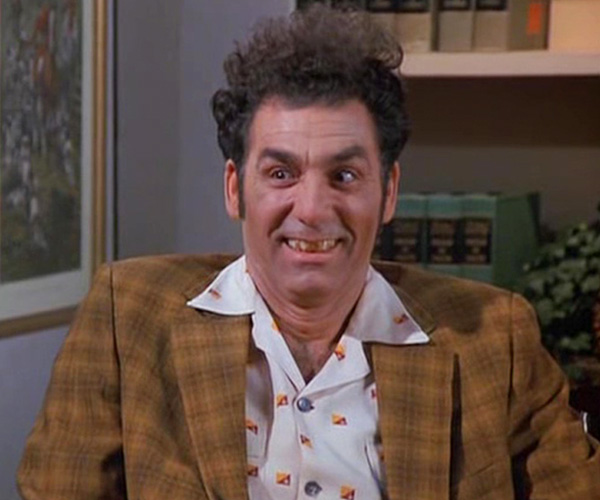
 "Kramer"
A Jeopardy category was actors who never won EMMYs, including Jackie Gleason, Angela Lansbury, Andy Griffith, George Clooney, and, unbelievably, Jerry Seinfeld.  Ditto Jason Alexander, but fellow “Seinfeld” cast members Julia Louis-Dreyfus and Michael Richards as Elaine Benes and Cosmo Kramer won several times.  Go figure.
Tamazina Tesanovich in Split;  Frank Barich wedding picture
Cindy C. Bean posted photos Croatian relatives originally from the Dalmatian coastal city of Split. Three decades ago, I had the opportunity to participate in a week-long American Studies conference in Dubrovnik sponsored by Indiana University.  On our flight from Germany I met a charming ten-year-old traveling to visit her grandmother in Split, a city of 300,000 people. On my first day in Dubrovnik, we took a boat trip on the Adriatic to Split. Walking around near where we docked, I spotted the girl in her grandmother’s backyard.  I asked if she wanted to show me around, she got permission, and off we went, ending at a gelato stand.  Unimaginable in the U.S.  We corresponded for several years, often talking about our favorite bands (we both liked REM).

Ray Smock commented on Trump’s most recent sickening display of demagoguery:
  Trump, having been rewarded for his many racist comments and his long assault on the previous president through his “birther” movement, a racist ploy which helped him get elected, publicly uttered to the world through Twitter: “So interesting to see “Progressive” Democrat Congresswomen, who originally came from countries whose governments are a complete and total catastrophe, the worst, most corrupt and inept anywhere in the world (if they even have a functioning government at all), now loudly......and viciously telling the people of the United States, the greatest and most powerful Nation on earth, how our government is to be run. Why don’t they go back and help fix the totally broken and crime infested places from which they came. Then come back and show us how....it is done. These places need your help badly, you can’t leave fast enough. I’m sure that Nancy Pelosi would be very happy to quickly work out free travel arrangements!”
  The President was not finished. When criticized, he always goes on the attack. He has never apologized for anything. Today he followed up his earlier remark by suggesting that the four congresswomen leave the country if they didn’t like it here. This reminded me of the kind of divisive bumper-sticker chant we heard during the protests against the Vietnam War: AMERICA: LOVE IT OR LEAVE IT. Who had the right then, or the right now, to tell any American to leave his or her own country? 
  The president said today, “These are people that hate our country. They hate our country. They hate it, I think, with a passion.” He cannot understand why anyone would criticize him or his policies. He can’t understand that all Americans have constitutionally guaranteed rights to petition the government for a redress of our grievances. Trump has wrapped himself in the flag and said these four young, bright, talented women hate America. Trump thinks HE is America. But he is only a temporarily elected official. It is as American as apple pie to criticize the President.  It has always been so. Trump is blind to this obvious fact. He thinks an attack on him is an attack on America. This is a form of sickness. 
    I do not know how far the president will go to keep this escalation going. He has already gone far beyond decency. Nancy Pelosi called the president’s remarks “xenophobic” and this is putting it accurately, but mildly. 
    The president’s incendiary remarks and his own obvious anger puts the lives of these four women in danger. It also divides the nation even more while he empowers racism in others. Trump is so flawed, so caught up with his own power, that others in his own party must step forward and muzzle him when he utters such outrageous things. This is intolerable speech from any American and it is filth beyond all measure when it comes from the President of the United States. 
    As shocking as is the president’s blatant racism, his misogyny, and his xenophobia, it is matched in shock value by the utter silence of the Republican Party. It is his own party that bears the greatest burden of responsibility for him. It is the Republicans who must act now if they are going to be able to say to the world that they are not as racist and as filled with hatred as is the president. Do Republicans want to embrace racism just to win elections for another generation? At what cost to the nation? If the Republican Party has even a hint of the Soul of Lincoln left in it, it must call for the president’s immediate resignation.
Janet Bayer pointed out that Somalia-born Minnesota Representative Ilhan Omar has been a citizen longer than Melania Trump. The three others were born in the United States.
 above, Rep. Ilhan Omar; below, Governor Henry Horner

The Summer 2019 Abraham Lincoln Association newsletter For the People reprinted an unpublished, undated typescript historian Benjamin P. Thomas (“Abraham Lincoln: A Biography,” 1986) composed about two-term Illinois governor Henry Horner. Jewish, a bachelor, and a Democrat elected in 1932, Horner was subjected to unfair slurs about his religion, manhood, and perceived lack of compassion (he was a fiscal conservative).  Probably written shortly after Horner’s death in 1940, the elegy describes Horner’s periodic nighttime drives when lonely and troubled with a state policeman from Springfield to New Salem 20 miles away, where young Abe Lincoln opened a general store in the prairie village.  Thomas wrote: “Lincoln had failed and gone into debt, but had risen from that and other failures to go on to greatness.”  Thomas continued: “The governor also remembered that it was in this little prairie village that Lincoln had gained faith in himself and in the people – those twin faiths without which a democratic ruler cannot govern wisely.
above, young Abe Lincoln
George Sladic posted shots of Hobart's old grist mill water wheel and lake George at sunset.

Tuesday, March 22, 2016

Lake Rats


“At Crown Point, where I graduated in 1967, kids would call those of us from Cedar Lake “Lake Rats.”  At times it was a little rough because of the stigma.”  Bob Carnahan
 logo for the indie band Lake Rats
I’ve been enjoying Jeff Manes’ “All Worth Their Salt: The People of NWI,” volume II, which includes interviews with such IUN colleagues as archivist Steve McShane, reference librarian Barb Kubiak, former Communication Department secretary Dorothy Mokry, former Labor Studies prof Ruth Needleman, and former A+ student of mine Bob Petyko.  A self-described “Lake Rat,” Petyko now teaches at MacArthur Elementary in Cedar Lake, which he attended during the 1950s.  He worked for Standard Forge in East Chicago after high school and started college at IUN at age 41.  Petyko wrote so compellingly about growing up poor in Cedar Lake that it inspired me to edit a special Steel Shavings issue on his historic hometown.  It proved to be controversial because of Petyko’s candid coming-of-age story about, in Petyko’s parlance, “the wages of sin” (at least in the eyes of respectable society) set against a backdrop of class and generational conflict.  In 2008 Petyko told Manes:
  I remember my third grade teacher giving me a bag of clothes because I had only one pair of pants to wear to school everyday.  I wore an old pair of dad’s shoes – size 11s.  That was embarrassing.  But at MacArthur there were a lot of kids like me.
  I had five brothers.  We’d prop a garbage can inside the front door so we’d know when the old man came home drunk.  My dad was the kind of guy who would hit you while you were asleep.

Petyko recalled Cedar Point Park a half-century ago:
  I grew up in a pretty bad neighborhood.  When my father had a job in Illinois, he’d stay the whole week in Chicago and come out weekends on the bus.  I found out later that he had a girlfriend in Chicago.  He was a butcher.  He’d give my mom maybe $60 a week, and that would keep us going.  We didn’t have a car.  We didn’t even have a phone until 1967.  And, of course, my parents never owned a home.  The American dream, man.
  There were eight of us.  Whenever my dad lost his job, we’d get kicked out of the place we were living.  Then we'd move to another house.  We used to put our furniture on wagons and sleds.  We’d be like gypsies going through the neighborhood.  We liked to move in winter because it was easier to push the stuff.  All the neighborhood kids would help us.
  We lived in this one house that had a little lean-to addition where I slept.  Once it snowed, and the room caved in.  My mom took a sheet and thumb-tacked it up along the doorway.  We spent the whole winter like that.  It would be windy, and that sheet would flap around.  We didn’t have hot water.  When we flushed the toilet, we had to go to the lake to get a bucket of water to make it work.
  There were so many taverns, especially on the east side, that you couldn’t throw a rock without hitting one.  In one area of less than a mile there was Chatterbox, the VFW, the Amvets, Mother Tucker’s, Melody Hill, Coleman’s, and the Band Box.  The adults used to get hammered all the time.  Men, and women in my family’s case, they’d get tanked up.  When I was real young, my dad would send me down to the bar for beer or a bottle of Seagrams, and I’d just walk it home.  They’d put it on my dad’s tab.  There was never a problem about my being underage.
  Illinois people would drive around the Point, staring at us “porch monkeys.”  That’s what we were.  Everyone would sit on stoops with our clothes half on, and it must have been like a zoo to them.  I’m sure some must have said to guests, “I have to take you down here; you must see this.”  And they’d drive around and gape, as it to say, “Oh look.  It’s inhabited.”
  The first time I heard the phrase “Lake Rat” was from an older brother.  One of his teachers said, “Oh, I got the Lake Rat class.”  I think Crown Point people coined it.  I call myself a Lake Rat to this day and am proud of it.
  We bought Lake Rat patches for our blue jean jackets at a head shop in Chicago’s Old Town neighborhood.  My junior year they made us stop wearing our Lake Rat jackets to school.

Bob Petyko described his fourth grade students and colleagues at MacArthur to Jeff Manes:
  I have a couple kids who might be considered upper middle class, and then I have all these kids who are poverty.  That’s why I don’t give homework.  Besides, moms don’t like getting Cs.  My kids work for me: from the time they sit down until the end of the day.  They owe me that.
  The people at MacArthur have genuine love for the kids.  MacArthur is a special place.  Our custodian has a thing called Carnahan’s Helpers; the kids love and respect him.
At Gardner Center Friday Jeff Manes (above), a former steelworker, recited Carl Sandburg’s poem “The Mayor of Gary” and one of his own entitled “Thirst.”  I’ll use these lines in my upcoming talk at Calumet College:

Screech, roar, POOM! Blast.
Bells and whistles out the ass.

Gaudy knickknacks.  Goofy nicknames.
Bawdy jokes and poker games.

Preachers, bikers, pikers, thugs.
Dinosaurs and engineers.
Holy rollers.  Carpenteers.
Melters, blowers, hookers too.
A college boy from Whatzmatta U.

Lary Car and Sal O’Manders
Steamboat Jack and Gerry Manders.
Lead and coke gas tough to hack.
Our snot and spit is always black.

The time has come I’ve paid the bill.
Thirty years in the mill.
I woke up Saturday eager to learn the Semi-State basketball results. 21st Century Charter School lost despite 42 points from Eugene German (above). To my shock I read that a car sideswiped the bus carrying Griffith players to Lafayette. The driver lost control of her car after spilling coffee on herself.  The bus veered off I-65 and overturned.  There were scrapes and bruises aplenty, but, miraculously, no fatalities. 
 above, NWI Times photo by Jonathan Miano; below, Post-Trib photo by Rich Leber
 
In the NCAA third round IU won an exciting contest against longtime rival Kentucky to reach he “Sweet Sixteen.”   Facing off were Hawaii, where I received an MA, and Maryland, where I received a PhD.  I had one eye on the game while playing bridge at Brian and Connie Barnes’ house in Crown Point.  It remained close until the Terrapins went on a 12-2 run midway through the second half. 
The NWI Times has been highlighting the origins of Region communities.  According to LaPorte County historian Fern Eddy Schultz, its first resident of Westville was Miriam Benedict, who passed through the area during the 1820s with her husband on her way to Illinois.  When he died shortly thereafter, she moved to Westville, the story, perhaps apocryphal, goes, because an Illinois law prohibited widows from keeping their children. 

Nicole Anslover invited me to her History seminar on “The Media and Modern America.”  The topic was press coverage of the Vietnam War.  During the first part of class students discussed media treatment of current events, including North Korea firing off missiles, violence at Donald Trump rallies, and President Barack Obama’s historic visit to Cuba.  I got laughs speculating that an upcoming Rolling Stones concert in Havana will probably get more media coverage and again noting that Pope Francis has joined Twitter.  When I was teaching, sometimes I’d pass another classroom, hear laughter, and be slightly envious.  I normally did not go for laughs, but when they did occur, I generally was so focused on the lesson that it did not fully register.


Home Mountain Press delivered 400 copies of Steel Shavings, volume 45, to IUN’s mailroom.  As always, the cover design is topnotch and the color photos of the highest quality.  Since I basically underwrite its publication through a donation to IU Foundation, I’ve decided to give copies away rather than deal with all the necessary hoops that sales would entail.

For an oral history assignment in her Indiana History class Kaitlyn Ingram interviewed her “grandpa” Frederick William Ingram, born in 1943 to Zula and Fred Ingram in Valparaiso. Zula, born in 1912, grew up in Gary with 11 younger brothers and sisters whom she helped her mother, also named Zula, care for.  She married Fred Ingram in 1935 and had daughter Judy in 1936.  Fred, Jr., an only son, recalled:
Growing up was tough; we didn’t have the most money in the world, and because of it both parents were gone a lot. My sister had to watch after me and considered me a bother.  My father passed away when I was only 5, so I don’t remember him much.  Memories of my stepfather aren’t the fondest.  I looked forward to school each day despite walking 10 miles uphill to Northview Elementary, barefoot in the snow, of course.
Fred and Judy Ingram

Fred Ingram’s pet crow, named Joe, followed him everywhere, he claimed, telling a skeptical Kaitlyn:
This stupid old bird would sit in the tree outside my house, and as soon as I made the trek from our home on Campbell Street to school, he would fly right above my head and follow me all the way to school. He would sit in the tree outside of my fourth grade class window, and wait until I left, and then follow me home all over again. One day he was making a ruckus, and my teacher finally got fed up enough and yelled “Freddy, take your bird home now!”  I thought to myself, “Well thank you Joe,” because I took my sweet ol’ time walking home and back.

Fred recalled stepfather Jack Forman:
My mom really loved him, but I could not for the life of me figure out why. He was quiet, never seemed too interested in what was going on with anyone, and never seemed happy.  He wouldn’t let me play sports and instead wanted me to get a job or do something beneficial to the family. I was really good at basketball but never allowed to play so I became interested in hunting and fishing.  Once you were outside the Valparaiso city limits, where Vale Park Road is today, it was all country and good hunting land. My buddies and I had some good times out in those woods. We would go out in the morning and sit all day, hoping to find deer, but mainly ducks.  We usually wound up laughing so hard out that we scared all the dang birds away.

Fred and his buddies cruised Lincolnway at a time when gas was only about 25 cents a gallon.  After Fred graduated from Valparaiso High School in 1961, Zula, and Jack moved to Pakistan on business.  Fred enlisted in the service.  Stationed in Iceland, he intercepted and deciphered telegrams. He recalled:
Iceland was beautiful but cold and boring. I was out in the middle of nowhere with a bunch of guys. We ended up getting pet rocks.  We’d take them with us to the bar on our down days. We’d grab a seat, order a beer, and ask for a little dish to pour a little beer into for the pet rock.  They needed to have fun, too!  After my time in the service, my mother did not recognize me because I had grown so much. 

Fred hired in at Bethlehem Steel and began to save up money.  In January of 1967 the great Valparaiso snowstorm hit.  It took Fred almost 2 hours to drive home from the mill.  A couple days later, Fred and Kenny Jenkowski decided to attend the VU basketball game and to Tony’s Pizza Place afterwards. Fred told Kaitlyn, “That was where I met your grandma, and the rest is history. We dated and in May of ’67 we got married and that was that.” 
 Proud parents

In her paper Kaitlyn wrote that Fred and Roberta Ingram have been married 48 years.  Their first house was on Campbell Street, close to where he grew up. Eventually had one built a couple miles south in Morgan Township, where they still live.  In 1970 son Geoffrey was born.  A year later they found that Geoff had retinoblastoma in his left eye, necessitating its removal. Fred said, “It was horrible and terrifying but a blessing all in one because we found it fast enough to contain the problem.”  Paul, Kaitlyn’s father, came along in 1972. The boys were the best of friends growing up.  Like their father, they shared a love for sports, and Fred, vowing not to be like his stepfather, encouraged them. He coached Little League teams, played catch in the yard, and attended Geoff’s basketball and baseball games for Morgan Township and Paul’s track and field meets.  As time went on, Geoff and Paul got married and grandkids started arriving, much to Fred and Roberta’s delight.

         In 2000 Geoff, who had beaten cancer as a child, was diagnosed once again, this time terminal. Fred recalled: “It was a sinking feeling when he drove home from Indy and told us the news. It just wasn’t fair.  Knowing your child has a terminal illness and that there really isn’t anything you can do about it, that’s a pain that I wouldn’t wish on anyone ever.” Geoff passed away on April 1, 2001.  Kaitlyn’s grandpa, teary-eyed, confided, “No parents should ever outlive their child. That’s not how the world is supposed to be. But I suppose that’s life.”
 Proud grandparents

Tuesday, November 18, 2014

Union Station


“Railway termini are our gates to the glorious and the unknown.  Through them we pass out into adventure and sunshine, to them, alas! we return.” E.M. Forster
On a “Lost Gary” excursion Jerry Davich photographed Gary’s Union Station.  Facebook friend Candle Perry recalled: We used to pick up my gramma at Union Station on Christmas morning.  She made the trip from Philly every year.  I loved the look of the building, the smooth wood benches that were almost like church pews, and the echoes in the big room.  What a treat for a kid.”
Gary's Union Station, then and now
Built in 1910 at 185 Broadway between the tracks of the Lake Shore and Michigan Southern Railway and the Baltimore and Ohio, just four years after the founding of Gary, Union Station is structurally sound despite having been closed for 60 years.  Designed in the neoclassical Beaux Arts style, with a skylight and uniquely shaped windows, the building was used in the making of the 1951 Alan Ladd film “Appointment with Danger.”  During the past decade there has been a movement to convert it to a steel museum, but without matching funds from the city or philanthropic support from U.S. Steel, the plans fell through.

On the other hand, Union Station in Indianapolis, the nation’s first, opening in 1853, was transformed into a festival marketplace and hotel during the 1980s.  While it failed to be an enduring commercial hub, the hotel remains and the rehabbed building now houses businesses, museums, and a charter school.  Chicago’s Union Station, which dates from 1925, is still is use, as is New York City’s Grand Central Station and Philadelphia’s 30th Street Station.  To get to Phillies games at the old Connie Mack Stadium, I’d get off one stop before 30th Street.  When I commuted to Philly for summer jobs as a law office mailroom “delivery boy” during the early 1960s, I’d end up at the Reading Terminal at Twelfth and Market. 

For years a former student has been taking Ron Cohen to the Chancellor’s Medallion banquet, which honors big donors to IUN scholarships.  This year he paid ($125) his own way and reported that several faculty were on hand, including Tanice Foltz, Chuck Gallmeier, Jean Poulard, and Alan Barr, as well as former administrators Barbara Cope and Linda Anderson.  The program was essentially a repeat of the scholarship event in Tamarack the week before.

Son Phil pulled a groin muscle playing soccer and whether he’d play Sunday was a game time decision.  Dave won a doubles tennis match to determine top seed in his league.  Down 5-6 in the third set, he helped his partner hold serve to force a tie-breaker and clinched match point on a difficult overhead smash.

Green Bay massacred the Eagles Sunday, eliciting this Jim Spicer reply to my limerick predicting a Philadelphia victory:

“A football prognostication by Lane
Turned out to be rather lame
His Eagles, in fact
Ran into the Pack
Let's hope we don't hear him complain.”

During the plentiful football commercials I read a few chapters of Louisa May Alcott’s “Little Women,” which portrays an idealized family, poor but loving, during the Civil War.  In contrast to the novel, where the benevolent patriarch is off fighting for his country, Louisa May’s father, Bronson Alcott, was, according to Jane Yolen, a tyrant who “as a husband was a poor provider, as a parent mentally abusive, [and] as a husband frequently absent.”  An abolitionist and transcendentalist who “was an indifferent father to his youngest three girls and positively nasty to Louisa,” he expected women to do the drudge work (and in Louisa’s case, be the family provider through her writing), while he “turned to bizarre new causes and cultish behavior without regard for his family.”

I’ve been eliminated from the Fantasy Football playoffs.  Four of my starters were on bye weeks, and – typical of how the season has gone – the two wide receivers I played, DeSean Jackson and T.Y. Hilton – garnered a total of five points, while the two I kept on the bench, A.J. Green and DeAndre Hopkins, wracked up 26.  LeSean McCoy was galloping full speed ten yards from the goal line with nobody in front of him when he tripped on the slippery turf.

At a condo board meeting to consider raising monthly dues in order to prepare for new roofs in a few years, President Ken Carlson said that he and wife Lorretta will be driving to Columbus, Ohio, to deliver clothes that their church raised for Kenyan refugees.  Good people, they have built Habitat for Humanity homes in Africa.
After China and Myanmar, President Obama’s final stop on an eight-day Asian tour was Brisbane, Australia, for the G20 Summit.  Twenty years ago at an oral history conference in Brisbane, I talked about steelworkers’ tales.  One feminist pronounced my talk too apolitical.  Most participants were women, and at one point when in the bathroom I heard my critic yell out, “We’re coming in.”  Evidently the women’s facilities were inadequate; I didn’t stick around to see if she used a urinal.  On the final day a guy invited me to a party to watch the Brisbane Bears play in the Australian football Grand Finals.
David Porter and Kenneth Scott
Vietnam Veterans Memorial Fund has created a Wall of Faces online, part of a planned education center to complement the Memorial Wall. After a Times editorial mentioned that 15 photos were still needed of Region veterans, columnist Doug Ross obtained one from Karen Gribble of David R. Porter and another of Kenneth L. Scott from his brother Bernie, who told Ross that Kenneth was in Vietnam just nine days when killed by a sniper.  “The last time we saw each other,” Bernie told Ross, “we both knew we wouldn’t see each other again.”  He added: “It’s still rough, even after all these years.”

Vice Chancellor for Administration Joe Pellicciotti, retiring next May, has been with IUN since 1980 and headed SPEA for 13 years. Chancellor William Lowe wrote, Joe was appointed vice chancellor one month before the severe flooding that covered the entire campus that year and resulted in the destruction and ultimate demolition of Tamarack Hall.  The 2008 flood opened a year of facilities-related challenges that Joe, rightly, remembers as ‘Biblical,’ in range and severity.”

The epic 2008 flood closed IUN for two weeks.  After several days I needed to get to my office in Tamarack to retrieve valuable photos for Ray and Trish Arredondo’s forthcoming “Maria’s Journey,” which I helped edit.  After leap-frogging through standing water, I persuaded a campus policeman to let me in the building.  “You’ve got ten minutes,” he warned.  To my relief the photos were safe.  In fact, the History offices never flooded, but by the time I was officially allowed to return, the smell of mold was overpowering.

In Nicole Anslover’s WW II class I learned about the Red Ball Express (two one-way highways for truck convoys to transport supplies from European ports to the front) and Operation Market Garden (the September 1944 Allied offensive designed to circumvent the Siegfried Line and seize bridges across the Meuse and Rhine).  I knew about both but not their code names.  “A Bridge Too Far” captures the tragic inability to relieve paratroopers airlifted into Arnhem. Nicole stressed that despite the success of the Normandy D-Day landing, the bloodiest fighting lay ahead and hopes that the war would be over by Christmas were wishful thinking.

Brian Barnes sent me a copy of a sermon he delivered five years ago to his Unitarian congregation in Hobart about Abraham Lincoln’s Second Inaugural Address.  He noted that Lincoln and Charles Darwin, two of the greatest change agents of the nineteenth century, were born on he same day, February 12, 1809.  Though “Origin of Species” was in the Illinois state library in 1860, here is no evidence that Lincoln read it.  Barnes concluded: What is definitely known is that Abraham Lincoln was a lifelong fatalist finding comfort in Greek tragedies and Shakespeare’s plays. He seems to have had a hybrid faith with rationalist, Universalist, Unitarian, fatalist elements.”
On the phone with Gaard Murphy Logan, a former docent, we discussed Jeff Koons’ porcelain ceramic “Michael Jackson and Bubbles,” which sold for $5.6 million.  Jackson bought Bubbles when the chimp was six months old and traveled with him to Japan.  Bubbles slept in a crib in MJ’s Neverland bedroom, but eventually became too aggressive and got exiled to a Florida sanctuary.

Anne Balay is back from Puerto Rico and will join me for a couple hours Saturday at Gardner Center, where I will be selling “Gary’s First Hundred Years” at the annual Holiday Market.  I plan to give away my latest Shavings with her book on the cover to anyone who buys “Steel Closets” from her.