Showing posts with label Cindy C. Bean. Show all posts

Friday, June 12, 2020

A Clear Midnight


 “Tell my friends I’m coming down

 We’ll kick it when I hit the ground.”

   Paramore, “Hard Times,” from “After Laughter”


After reading in New York magazine about Hayley Williams, longtime vocalist for Paramore who just recorded a solo album, “Pearls for Armor,” I checked out Paramore’s 2017 studio album “After Laughter’ and put it on heavy rotation with Weezer, Daft Punk, Lush, and Bob Dylan’s “Blood on the Tracks.”  Paramore is often grouped with emo bands such as Panic! At the Disco (once a favorite of Becca’s) and Jimmy Eat World (one of my favorites) who grew out of the punk scene and feature confessional lyrics.  Here’s an example from Paramore’s “Fake Happy”:

I’m quite alright

Better hope I don’t blink

Delia Owens
At the library, open for curbside service I also picked up “Where the Crawdads Sing” by retired wildlife biologist and environmentalist Delia Owens, which I noticed Alissa was reading last weekend. A 2018 novel that was on the New York Times best seller list for 30 weeks, it takes place in a coastal marshlands of North Carolina.  NYT reviewer Marilyn Stasio called it a painfully beautiful first novel that is at once a murder mystery, a coming-of-age narrative and a celebration of nature.”  I’m intrigued.


New York magazine’s special issue, “Listening to the Very Old,” opened with a section titled “Long Lives: Old People have never been so powerful – or, now, so vulnerable.” A photo showed wheelchair-bound Bill Streiber peering at his son through a window at Solheim Senior Community in Los Angeles.  Amelia Schonbek interviewed 90-year-old former farmworkers organizer Dolores Huerta, who marveled at how quickly people can be mobilized into action on the internet.  She added:

    One negative thing about the online issue, though: You realize that you don’t know your neighbors.  Yesterday, on my daily walk, a women greeted me and said, “Are you Dolores Huerta?,” and it turns out she’s a schoolteacher.  And a man shouted, “Are you Dolores Huerta?,” and it turns out he just bought a house and he recognized me because he was active in a labor union in L.A. I guess we’ve had social distancing in a different kind of way about relating to our neighbors.  And that’s different than when I was young. When I was young, you knew everyone on the block.


Poet Susan Howe, 82, told Amelia Schonbek that lying down and going to bed, she thinks of Walt Whitman’s poem “A Clear Midnight,” written near the end of his life.  It goes:

THIS is thy hour O Soul, thy free flight into the wordless,

Away from books, away from art, the day erased, the lesson done,

Thee fully forth emerging, silent, gazing, pondering the themes
thou lovest best,

Night, sleep, death and the stars.

Howe’s poem “The Midnight begins:

For here we are here

BEDHANGINGS

daylight does not reach

Vast depth on the wall

Neophyte


On “Final Jeopardy” with the category “Pre-Civil War Presidents” the clue was, “After a grand tour of Europe he retired to a life of obscurity in Concord.”  One contestant, thinking of Concord, Massachusetts, guessed John Quincy Adams; I knew that was incorrect because Adams spent his final years as a member of the U.S. House of Representatives.  I knew it had to be New Hampshire native Franklin Pierce, like James Buchanan, whom he preceded, a Democrat who favored appeasing the South in a vain attempt to save the Union from Civil War. Next day, a “Jeopardy” clue asked where Noah kept the bees. It was a riddle Calumet Regional Archivist Steve McShane always asked his Indiana History students the first day of class.  Answer: the ark-hives.  When I told Steve about it, he replied, “They owe me royalties.”


Cindy C. Bean posted a photo of her grandmother’s Oak Forest bowling team, Pin Crushers, in 1973.  When I said I wish I had known her, Cindy replied: “She was so awesome! So ahead of her time! She ran their Flower and Garden shop and was also a cosmologist! She was extremely social! Always had her hair and nails perfect! She was great! You would have liked her!”


Guy Rhodes photographed East Chicago Central’s drive-thru graduation and posted

    I enjoyed my time this afternoon checking out East Chicago Central High School's first-ever drive through graduation ceremony, brought on by social distancing measures still in place for the COVID-19 pandemic. To my knowledge, this is the first time something like this has ever been done in the city's 127-year history. Students and families drove to several stations set up around the campus for gifts and hand-outs before students got out and walked a short distance to receive their diploma. A parking lot traffic island replaced the stage, a DJ playing popular music replaced a choir, and the resulting atmosphere was fun and lively. I later got word that more than a few people suggested it be done this way from here on out. 

Vanessa Hernandez Orange, left, (Coach V) added: “My go to guy, he’s the man who steps up and makes it happen. Whatever you need I got your back! You have had EC Students back for the past twenty something years!! I thank you from the bottom of my heart. Now let’s get drive through graduation going. Mr. Dave Lane, senior class sponsor, Honor Society Sponsor, English teacher, tennis coach, the voice of EC Athletics, the of Central High School. All love, Coach V”


Tuesday, January 7, 2020

Machines of Youth

“It’s a hard trip to the kitchen sink
’Cause I can’t wash this one clean.”
   “Stick,” Snail Mail (Lindsey Jordan)
Along with CDs by The Beths, Weezer, Lumineers, and Goo Goo Dolls, I’ve been listening to “Lush” by Snail Nail featuring teenager Lindsey Jordan that Alissa’s husband Jeff Leffingwell gave me at Christmas (it’s a favorite at his office).  The lush arrangements and lyrics of unrequited queer love are delivered with no trace of self-pity,  In fact, if I hadn’t read the liner notes, I wouldn’t have guessed how confessional the songs were.  Despite the plaintive plea to “Stick Around,” the lyrics of “Stick” also imply the termination of a sticky situation, one that can’t emotionally be washed clean. The album’s opening lyrics set the mood perfectly:
Go. Get it all.
Let them watch. Let them fall.
Nameless. Sweat it out.
They don’t love you.  Do they?
Grace. Born and raised.
Cut you down. Still bleeds the same.
As it is. For you anytime.
Still, for you. Anytime. 
Those responding to the above post included Alissa (“Glad you’re liking the CD, J-Bo”) and Cindy B. Bean, whose photos of Gary ruins have appeared in several of my publications.
 above, Larry and Cindy Bean; below, Gary girls at drive-in, 1957 by John Vachon

Ron Cohen loaned me “Machines of Youth: America’s Car Obsession” (2018) by Gary S. Cross.  It contains several references to my Fifties Steel Shavings (volume 23, 1994) on teen culture in the Calumet Region and a great John Vachon photo from Look magazine of Gary girls at a drive-in. “Machines of Youth” begins: “In modern America, growing up has meant getting a driver’s license, buying, driving, and maybe crashing the first car; the ritual of being picked up for the date and ‘making out’ in the front or back seat; even the pleasures of repairing, customizing or racing that car.”  I am cited mostly in the chapter “Cruising and Parking: The Peer Culture of Teen Automobility, 1950-1970.”  One reference mentions both sexes skinning dipping at night on beaches along Lake Michigan.
“Juliet Naked” (2018) features Ethan Hawke, one of my favorite actors, as Tucker Crowe, a Nineties indie rocker who dropped out of sight 25 years before but is still venerated by a few hundred fanatical fans, including Duncan, played by the endearing Chris O’Dowd, whom I found so amusing in a similar role in Judd Apatow’s comedy “This Is 40” (2012).   As much as I enjoyed those characters, the women were even more compelling, including Tucker’s pregnant teenage daughter, who comes back into his life after ten years.  Unbeknownst to Duncan, his long-suffering mate Annie (Rose Byrne) develops an online relationship with Tucker that blossoms into a romantic friendship after Duncan takes up with a younger woman.  Annie, manager of a museum in an English seacoast town, curates an exhibit highlighting the summer of 1964.  One old photo shows two young couples by the beach.  At the opening 84-year-old Edna, one of the four, identifies herself and her date:  It was George, mmm, he was a fast worker. He wanted a bit of fun. I wish I did too, but I fought him off. I thought, ‘Edna, you can never go wrong not doing something. It's the things that you do that get you into trouble. Here I am 84 years old and I've never been in trouble in my whole bloody life. Goddammit!’   
Annie takes Edna’s lament to heart.  Up to this time, her chief sexual pleasure came from a dildo-shaped vibrator, in contrast to her lesbian younger sister Ros, who is with a new lover each time they meet. When Ros brags that her latest is a gold star, meaning never had sex with a man, Annie doesn’t know what that means.  Annie decides to move to London, reconnect with Tucker, and be open to new experiences. My favorite scene: coerced to perform at Annie’s museum, Tucker sings the Kinks’ “Waterloo Sunset.” 
                      Alissa Yoshitake and Dean Bottorff with Angie
Several Holiday cards came with newsletters describing 2019 family highlights.  Good liberal Lois Hart’s came redacted, emulating the Mueller Report that documented Trump’s obstructions of justice.  Many mentioned beloved pets; in fact, the Yoshitakes, California relatives whose daughter Alyssa recently graduated from the University of Cincinnati Conservatory of Music (where Becca had a try-out), was composed as if written by new cat Emmy:
  They told me that my predecessor, 17-year-old Ariel, who went to the “rainbow bridge,” didn’t do her job last year.  They say that’s the way cats are.  I didn’t know any better because I am only 6 months old and I act more like a greyhound than a kitten sometimes.  The place I came from (the Humane Society) was really scary busy.
Dean and Joanell Bottorff’s began:
  Where to start.  Maybe order of importance.  Angie got fed this morning and every morning throughout the year.  Not once did she forget to remind us to put food in her bowl.  Best of all, for several months, she got extra scraps of beef trims, left over from the Wykoff (SD) Volunteer Fire Department Picnic and daughter Ann’s birthday celebration.  You may not think that having your bowl filled every morning is the most important event of the year, but then you are probably not a dog.
Gayle and Ed Escobar’s included photos of their China trip, a new grandchild, and, most prominently, their cat.

In a PBS interview with David M. Rubenstein published in a new book (“The American Story”), Chief Justice John Roberts spoke briefly of growing up in Northwest Indiana but left out that his father was plant manager at the Bethlehem Steel plant in Burns Harbor, and the family resided in the affluent beachfront community of Long Beach.  Roberts attended Notre Dame Elementary School and the exclusive La Lumiere private school in La Porte (I passed the grounds en route to Halberstadt Game Weekend), where he was an honor student, student council officer, a Regional champion wrestler, and captain of the football team.  While at Harvard Roberts majored in history and  anticipated a future in academia until a taxi cab driver told him he’d also been a history major at Harvard. Realizing that job prospects for historians were grim (just as they had been 50 years ago and remain today), the practical Hoosier decided to set his sights on law school.

Reviewing Richard A. Hall’s “Pop Goes the Decade: The Seventies” for Choice magazine and being limited to 190 words, I couldn’t fit in the comic genius of filmmaker Mel Brooks, that “High Fives” originated in the 1970s, or that future tech behemoths Apple and Microsoft started then.  In many ways the Seventies was my favorite decade. On the cover: John Travolta, Richard Nixon and “Wonder Woman” actress Lynda Carter.  My choice would have been the original Saturday Night Live cast.

Monday, July 22, 2019

Wishlist

“I wish I was a messenger and all the news was good,
I wish I was the full moon shining off a Camaro’s hood.”
    “Wishlist,” Pearl Jam
 59-year veteran steelworker John Gold; photos by Jerry Davich
Jerry Davich wrote a Post-Tribunecolumn on steelworkers who put in 50 years at the mill, despite the dirty, unhealthy, dangerous environment, forced overtime, and constant shift work that, as one veteran exclaimed, took ten years out of your life. Why would someone do that, he wondered. Some feared they’d soon die if they retired.  Others, proud to be called steelworkers, claimed to like the workplace camaraderie and being productive.  Others didn’t have much of a home life and preferred not to be in the house all high wages that paid for maintaining a middle-class lifestyle, including the ability to send children and grandchildren to college.  Replying the Davich’s column, Carla Waters Spencer stressed the economic security a mill job provided her family: My dad worked at US Steel for 52 years in the coke plant, retiring after my mom was diagnosed with cancer because she needed his help at home. Mom and Dad were able to raise the four of us kids, pretty much on his income, and we wanted for nothing.”Valerie Dixon commented:
  My dad worked at USS for 46 years! He started out in a dirty section and moved to an overhead crane in shipping at the sheet and tin mill; loading coils. He had health problems for as long as I can remember; one being thyroid problems. They didn’t use hearing protection back then either and the damage was done by the time he started wearing ear plugs. The shifts they had them work were stressful: 1 week days,1 week 4 to 12’s, 1 week midnights; alternating until a vacation. They did have great vacation benefits back then; 13 weeks every so many years. Traveling the country during those paid weeks off were the best childhood memories.
Cindy C. Bean posted a photo of hubby Larry posing with Jerry Davich’s “Lost Gary” at Sam’s Club and one she took of a window in an abandoned church. 
 Cubs fan Eddie Vedder of Pearl Jam
I’m approaching my golden anniversary being associated with IU Northwest.  I still go in to the office four days a week and keep active intellectually guest lecturing and writing a blog.  I am vain enough to believe that my Steel Shavingsmagazine and work with the Calumet Regional Archives has lasting value. There are no exotic vacation spots or adventurous feats on my wish or bucket list beyond continuing what I do now, including travel to scholarly conferences.  Like Eddie Vedder of Pearl Jam, in 2016 I witnessed the Chicago Cubs win the World Series for the first time in our lifetimes, near the top of both our wish lists. Recently, Vedder talked about his love affair with the Cubbies:
  It probably started because my grandpa took me to Wrigley Field. The first day I was about 4 and a half or 5, we saw the Pirates play the Cubs. When we came up the bleachers, you could smell the stench of one of those white capsules in the piss thing. That was the smell, mix it with hot dog, and walking up the ramp and I could hear the pop of the gloves, it was a Wizard of Oz moment to see that field for the first time.  It was the greenest green I ever, the whitest white, Jose Cardenal, the coolest afro. That moment I feel something inside changed, and a fire was lit. 
 Brandy Halladay at Hall of fame ceremony
Inducted into the Hall of Fame in Cooperstown, NY, were six worthy candidates, including Cub reliever Lee Smith, White Sox clutch hitter Harold Baines, and Phillies ace Ray “Doc” Holladay, who died two years ago when his small plane crashed into the Gulf of Mexico.  He’d been suffering from depression and addiction to pain medication and may have taken his own life.  Joining Philadelphia in 2010, Holladay pitched a perfect game that May and won postseason contests against Cincinnati and San Francisco, the eventual World Series champs.  Lee Smith thanked his Castor, Louisiana, school principal for buying equipment his family couldn’t afford, enabling him to play baseball. Yankee closer Mariano Rivera, the Hall of Fame’s first unanimous selection and final speaker, joked that he’s always the last one called on.
 army troops march down Broadway in Gary during 1919 steel strike
Robert Blaszkiewicz’s mention of the 1919 Chicago Race Riot reminded me that I taught an entire course about that fateful year and used William M. Tuttle’s “Race Riot: Chicago in the Red Summer of 1919.”  Racial disturbances also erupted in Washington, D.C., Omaha, Nebraska, Tulsa, Oklahoma, and throughout the South.  Required reading included Robert K. Murray’s “Red Scare: A Study in National Hysteria” and David Brody’s “Labor in Crisis,” about a nationwide steel strike during which army troops invaded Gary at pro-business Mayor William Hodges’s invitation, jailing union leaders, and crushing the strike.   The class read the coming-of-age novel “Winesburg, Ohio” by Sherwood Anderson and Gene Smith’s “When the Cheering Stopped: The Last Years of Woodrow Wilson,” which details the President’s incapacitation during the Versailles Treaty ratification fight. I offered the course 55 years after these events, which seemed like ancient history – about the same number of years past as the March on Washington and John F. Kennedy’s assassination. An older student recalled listening to news of Charles Lindbergh’s 1927 solo flight across the Atlantic.
Momma Mia! cast: Kolsch front, middle; Romersberger back, third from left
Toni and I thoroughly enjoyed “Momma Mia!” at Memorial Opera House.  We first saw the play in Las Vegas and enjoyed both the movie starring Meryl Streep and its sequel, featuring an iconic cameo by Cher singing “Fernando.”  The best numbers were the upbeat ones involving the entire cast, including lively dancers led by long-legged Jordyn Romersberger (an instructor at Mirror Image Studio) and athletic, blond-wigged VU grad Carley Kolsch.  Bobbie Sue Kvachkoff shined as Tanya and Mark Williams as rich Englishman Harry, one of momma Donna’s three former lovers.  That fling was his last heterosexual affair, Harry confided.

“We lived poor as dump dogs,”a character declares in John Updike’s “My Father on the Vege of Disgrace,” a great expression I’d never heard before. The short story, from “Licks of Love” (2000), takes place in a town west of Philadelphia not unlike my hometown, Fort Washington, six decades before:
    In this present day of strip malls and towns that are mere boundaries on a developer’s map, it is hard to imagine the core of authority that existed then in small towns, at least in the view of a child – the power of righteousness and enforcement that radiated from the humorless miens of the central men.  They were not necessarily officials; our town was too small to have many of them.  But certain local merchants, a clergyman or two, the undertaker whose green-awninged mansion dominated the main intersection, across from a tavern and a drugstore, not to mention the druggist and the supervising principal of the school, projected a potential for condemnation and banishment.
One of Midge’s chief concerns concerning my aberrant youthful behavior could be summed up by the warning, “What would neighbors think?”  When I came home from college, she’d always drag me to church until I showed up with a beard.  That Sunday, church was never mentioned. Unlike Toni, whose Catholic upbringing fostered feelings of guilt, for me the emotion was shame, not so much what I did but how it would look.
Time’s Lucy Feldman interviewed Richard Russo, about his new novel, “Chances Are.” Responding to a critic who unfairly called him a misogynist, Russo said, “I have to admit, having been raised a Catholic, my first instinct when anybody says anything bad about me is always to say, ‘God, is that true?’”   Attending the University of Arizona in 1969 at the time of the first draft lottery, he recalled joking around with friends initially and then everyone drifting away to call home. His number was 332, which he gave to a character that also inherited some of his idiosyncrasies.  Ruminating over his own fate, Russo stated: “There are certain times when it’s good to be industrious, but that night it was good to be lucky.”  He elaborated:
 There are certain things that are fated, that no matter how hard we try are beyond our ability to alter or shape. There are certain things over which we do have agency.  And then of course there is dumb luck.  But suppose you put me in the exact same place where I started, with the same parents, living on the same street and you give me 99 more tries.  There would be 99 different outcomes.
 
The town of Highlight’s Pride Day celebration featured entertainment (including Eve Bottando playing accordion), interesting displays of all sorts, and spontaneous outbursts of enthusiasm among the LGBTQ participants and supporters. One couple getting married changed in a dressing room along with drag queen who made a big fuss over them.

Dave is attending a conference for teachers in San Antonio, a place I wouldn’t mind visiting that’s evidently been well-governed by Henry Cisneros during the 1980s and, between 2009 and 2014, Julian Castro, whom I hope is on the 2020 Democratic Presidential ticket. 
 

On Jeopardy nobody knew what Kurt Vonnegut novel time traveler Billy Pilgrim was in (easy, “Slaughterhouse Five”) or, on Final Jeopardy, which landmark African explorer David Livingston discovered. I figured it was either Mount Kilimanjaro or Victoria Falls and correctly guessed the latter. The guesses included Mount Kilimanjaro, sources of the Nile, and Timbuctoo.

Monday, July 15, 2019

Life of Illusion

“Sometimes, I can’t help but feeling that I’m living a life of illusion.” Joe Walsh, “Life of Illusion”
I love starting the weekend listening to WXRT’s “Saturday Morning Flashback,” especially when I can hear such 1981 favorites as “The Voice” by Moody Blues, “Shake It Up” by the Cars, “867-5309 (Jenny)” by Tommy Tutone and surprises such as “Champagne and Reefer” by Muddy Waters and “Life of Illusion” from the album “There Goes the Neighborhood” by guitar great Joe Walsh, whom I saw live in Merrillville with Ringo Starr and His All-Star band.  “Life of Illusion” dispenses this advice:
Hey, don't you know it's a waste of your day
Caught up in endless solutions
That have no meaning
Just another hunch, based upon jumping conclusions
Backed up against a wall of confusion

The new Morrissey CD “California Son” contains covers of songs originally recorded by the likes of Bob Dylan, Buffy Sainte-Marie, Joni Mitchell, and Phil Ochs. “Days of Decision” by Ochs strongly resembles “These Are Days” by Natalie Merchant and 10,000 Maniacs. To my surprise one track was the Roy Orbison classic “It’s Over.”  When with the Smiths, Morrissey wrote and recorded a different number titled “It’s Over.” Orbison’s lyrics end:
All the rainbows in the sky start to even say goodbye
You won't be seeing rainbows any more
Setting suns before they fall, echo to you that's all that's all
But you'll see lonely sunset after all
Morrissey gives it a good go, but nobody conveys the heartbreak of losing a loved one like the legendary Roy Orbison.  At the end of a recent episode of “Big Little Lies” I heard Orbison’s breathtaking version of “It’s Over."
Jerome Allen and son Roman in 2017
Boston Celtics assistant coach Jerome Allen grew up in Philadelphia’s Germantown projects, sharing spece with 18 relatives.  He went on to star for the University of Pennsylvania, and after a ten-year pro basketball career mostly abroad, became the Quakers head coach.  Allen founded HOOD (Helping Our Own Develop) Enriched, a basketball and tutoring initiative for underprivileged kids.  Caught up in the Varsity Blues scandal, Allen, it developed, had accepted $300,000 to gain a multi-millionaire’s son admission to the Wharton business program by claiming falsely that he was a talented recruit. Allen shattered admirers’ illusions as a result of financial problems compounded by fear that he’d soon be fired due to a mediocre 65-104 record in six seasons.  The donor promised to be a big Penn supporter and his friends for life. Overly generous to boys in his old neighborhood, he had expensive tastes in cars and clothes and sent his children to elite private schools. Briefly suspended by the Celtics after a plea bargain agreement that left him basically a free man, Allen resumed coaching duties, beloved, Ben Baskin of Sports Illustrated claimed, by players.  Celtic forward Marcus Morris called Jerome Allen “the backbone coach of the team.”

The theme of John Updike’s “The Woman Who Got Away,” the inanity of sexual promiscuity, is similar to the novelist’s best-selling “Couples,” which caused a sensation when published three decades earler in 1968, the apex of the so-called sexual revolution.  Marty, a liberal arts professor free of illusions, looks back at his days as a philanderer and concludes that the women who remain most vivid are the ones he failed to sleep with.  Audrey, a redheaded faculty wife who got away “remained loyal to the long, ironed hair of the flower child era years after the flower children had gone underground or crazy or back to their parents.” Marty last spotted her at a New Hampshire mall on the former site of a dairy farm (“chain stores in postmodern glass skins, and a vast asphalt meadow,” its arcade “a parody of an old-time Main Street”).Divorced, Audrey was holding hands with Winnifred, “wearing trousers and a feathery short white hairdo and a quilted down vest,”another woman who got away.
Artist Robyn Feeley’s vibrant pastels on display at Gardner Center in Miller featured colorful images of living creatures in frames made from recycled ceramics, beach stones, and glass found along the Lake Michigan shoreline.  The pieces, including yard ornaments and birdhouses, were quite striking; many had been sold by the time I visited the gallery.  Robyn was one of the original owners of Miller Bakery Café.

At Miller Farmers Market I ran into Cullen Ben-Daniel, founder of the Miller Historical Society, who recently converted a 14-room rehabbed house into an airBnB.  Even though it’s a good six blocks from the beach, he charges $450 a day and has been booked solid on weekends from May through early October, with only had two bad experiences (a wild party and the inground pool left discolored).  Evidently dozens of homes in Miller are listed on airBnB websites.  Some communities have attempted to limit, ban or place crippling restrictions on short-term home-rentals, but according to Ben-Daniel, so far groups such as the MCC (Miller Citizens Corporation) have made no such efforts.
 Selena Rosas, Dave, Eric Kundich at Rick's Boatyard cafe in Indy


At granddaughter Becca’s seventeenth birthday party I consumed two delicious tacos and generous portions of guacamole, salsa and chips.  Stuffed, I took my cake home for later.  Home from a teachers conference in Indianapolis, where he ran into former student Selena Rosas, Dave was setting up karaoke downstairs for the high schoolers as we were leaving.
In “Bohemian Rhapsody” the portrayal of Freddie Mercury’s family, Parsi immigrants originally from Gujarat, India and then Zanzibar, Tanzania, was compelling. Born Farrokh Bulsara in 1946, Freddie was derogatorily called a Paki, short Pakistani.  Parsi migration to the Indian subcontinent commenced over a thousand years ago during the Muslim conquest of Persia.  The Bulsari family still practiced the Zoroastrian religion.  Though Freddie was late to win his father’s approval, he had loving parents. A scene where they accept that he has a male lover was especially moving. Freddie promised his mother he’d blow her a kiss at the end of Queen’s 20-minute Live Aid set; and when he did, I teared up.  Six years later, he succumbed to AIDS-related pneumonia.  Accompanying the credits were family photos; the actors were almost dead ringers for family members and Queen band mates. Freddie was cremated in the Zoroastrian fashion; traditionally, in the old country, corpses are laid out in the sun and consumed by birds of prey.

In “We’ll Always have Casablanca, July’s book club selection,” Noah Isenberg claimed that in 2007 the film was the most frequently played on TV.  It was discussed by the characters Billy Crystal and Meg Ryan play in “When Harry Met Sally” (1989), spoofed on “The Simpsons” and twice on “Saturday Night Live,” and referenced in hundreds of other TV shows and movies, from James Bond’s dinner jacket in “Goldfinger” (1964) to the café scene in “Raiders of the Lost Ark” (1981). Isenberg concludes that there is no appetite for a Casablanca sequel, quoting film historian Jeanine Basinger: “Leave them in all that glamorous fog on the Casablanca tarmac, fat brims pulled down low, morals ramped up high, no future necessary.”

Viewing “Casablanca” at Gino’s with book club members and guests prior to the meeting, I was struck by the clever dialogue and comic moments, such as a pickpocket at work and Claude Rains as French Captain Louis Renault.  Once instructed by German Major Strasser to close down Rick’s establishment, he says, “I’m shocked to find that gambling is going on here” right before accepting his winnings from the croupier. After witnessing Rick shoot Strasser, he utters the still famous line, “Round up the usual suspects.”
Brian Barnes gave an excellent presentation, confiding to me afterwards that he took my advice and concentrated on one chapter, describing the many emigres in the cast, including refugees from Hitler who played Nazis. In addition, he mentioned problems getting around the censors when it came to matters of sex and the many reference to “Casablanca” in films, including “Star Wars” and Woody Allen’s “Play It Again, Sam.” He revealed that when “Casablanca” won the Academy Award for Best Picture,” studio boss, listed as executive producer, accepted the Oscar as Warner family members blocked Hal Wallis, the producer responsible assembling the cast and bringing it all together, from reaching the stage.  Barnes identified the central theme as overcoming disillusionment and choosing commitment to a cause when confronted with evil in the world.  He contrasted artistic control of Orson Welles in the making “Citizen Kane” with the movie factory conditions Wallis had to work with. I noted that Roger Ebert called “Citizen Kane” the best movie he ever saw and “Casablanca” the most enjoyable film he ever viewed.  Debra Dubovitz noted that when she saw “Casablanca” at an IMAX, the audience clapped at the end.  Sometimes in theaters cult followers clap each time the various actors make their first appearance.
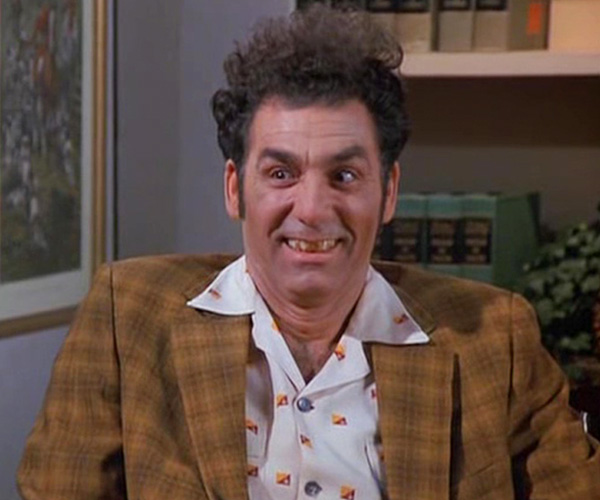
 "Kramer"
A Jeopardy category was actors who never won EMMYs, including Jackie Gleason, Angela Lansbury, Andy Griffith, George Clooney, and, unbelievably, Jerry Seinfeld.  Ditto Jason Alexander, but fellow “Seinfeld” cast members Julia Louis-Dreyfus and Michael Richards as Elaine Benes and Cosmo Kramer won several times.  Go figure.
Tamazina Tesanovich in Split;  Frank Barich wedding picture
Cindy C. Bean posted photos Croatian relatives originally from the Dalmatian coastal city of Split. Three decades ago, I had the opportunity to participate in a week-long American Studies conference in Dubrovnik sponsored by Indiana University.  On our flight from Germany I met a charming ten-year-old traveling to visit her grandmother in Split, a city of 300,000 people. On my first day in Dubrovnik, we took a boat trip on the Adriatic to Split. Walking around near where we docked, I spotted the girl in her grandmother’s backyard.  I asked if she wanted to show me around, she got permission, and off we went, ending at a gelato stand.  Unimaginable in the U.S.  We corresponded for several years, often talking about our favorite bands (we both liked REM).

Ray Smock commented on Trump’s most recent sickening display of demagoguery:
  Trump, having been rewarded for his many racist comments and his long assault on the previous president through his “birther” movement, a racist ploy which helped him get elected, publicly uttered to the world through Twitter: “So interesting to see “Progressive” Democrat Congresswomen, who originally came from countries whose governments are a complete and total catastrophe, the worst, most corrupt and inept anywhere in the world (if they even have a functioning government at all), now loudly......and viciously telling the people of the United States, the greatest and most powerful Nation on earth, how our government is to be run. Why don’t they go back and help fix the totally broken and crime infested places from which they came. Then come back and show us how....it is done. These places need your help badly, you can’t leave fast enough. I’m sure that Nancy Pelosi would be very happy to quickly work out free travel arrangements!”
  The President was not finished. When criticized, he always goes on the attack. He has never apologized for anything. Today he followed up his earlier remark by suggesting that the four congresswomen leave the country if they didn’t like it here. This reminded me of the kind of divisive bumper-sticker chant we heard during the protests against the Vietnam War: AMERICA: LOVE IT OR LEAVE IT. Who had the right then, or the right now, to tell any American to leave his or her own country? 
  The president said today, “These are people that hate our country. They hate our country. They hate it, I think, with a passion.” He cannot understand why anyone would criticize him or his policies. He can’t understand that all Americans have constitutionally guaranteed rights to petition the government for a redress of our grievances. Trump has wrapped himself in the flag and said these four young, bright, talented women hate America. Trump thinks HE is America. But he is only a temporarily elected official. It is as American as apple pie to criticize the President.  It has always been so. Trump is blind to this obvious fact. He thinks an attack on him is an attack on America. This is a form of sickness. 
    I do not know how far the president will go to keep this escalation going. He has already gone far beyond decency. Nancy Pelosi called the president’s remarks “xenophobic” and this is putting it accurately, but mildly. 
    The president’s incendiary remarks and his own obvious anger puts the lives of these four women in danger. It also divides the nation even more while he empowers racism in others. Trump is so flawed, so caught up with his own power, that others in his own party must step forward and muzzle him when he utters such outrageous things. This is intolerable speech from any American and it is filth beyond all measure when it comes from the President of the United States. 
    As shocking as is the president’s blatant racism, his misogyny, and his xenophobia, it is matched in shock value by the utter silence of the Republican Party. It is his own party that bears the greatest burden of responsibility for him. It is the Republicans who must act now if they are going to be able to say to the world that they are not as racist and as filled with hatred as is the president. Do Republicans want to embrace racism just to win elections for another generation? At what cost to the nation? If the Republican Party has even a hint of the Soul of Lincoln left in it, it must call for the president’s immediate resignation.
Janet Bayer pointed out that Somalia-born Minnesota Representative Ilhan Omar has been a citizen longer than Melania Trump. The three others were born in the United States.
 above, Rep. Ilhan Omar; below, Governor Henry Horner

The Summer 2019 Abraham Lincoln Association newsletter For the People reprinted an unpublished, undated typescript historian Benjamin P. Thomas (“Abraham Lincoln: A Biography,” 1986) composed about two-term Illinois governor Henry Horner. Jewish, a bachelor, and a Democrat elected in 1932, Horner was subjected to unfair slurs about his religion, manhood, and perceived lack of compassion (he was a fiscal conservative).  Probably written shortly after Horner’s death in 1940, the elegy describes Horner’s periodic nighttime drives when lonely and troubled with a state policeman from Springfield to New Salem 20 miles away, where young Abe Lincoln opened a general store in the prairie village.  Thomas wrote: “Lincoln had failed and gone into debt, but had risen from that and other failures to go on to greatness.”  Thomas continued: “The governor also remembered that it was in this little prairie village that Lincoln had gained faith in himself and in the people – those twin faiths without which a democratic ruler cannot govern wisely.
above, young Abe Lincoln
George Sladic posted shots of Hobart's old grist mill water wheel and lake George at sunset.